
The mid-twentieth century brought significant change in transportation. As car ownership increased, reliance on rail transport declined. Passenger numbers dropped steadily, making services uneconomical.
The local newspaper, the McIvor Times, reported that passenger numbers on the Wallan-Kilmore-Heathcote line had been declining for several years to the point where it was no longer viable.
“In a statement on the stopping of the service, the Minister of Transport, Mr ER Meagher, said the passenger traffic on the line had steadily diminished in recent years to a stage where it was uneconomic,” the newspaper read.
“Mr Meagher added that the daily passenger traffic on the rail motor varied but had been as low as three on a trip with most passengers travelling to and from Kilmore to the city.
“From Kilmore to the other stations the loading had been between six and eight passengers, with the average arriving at Heathcote only two or three.”
Given that Kilmore passengers were also served by the line running through Kilmore East the closure of the line in June 1965 was regarded as inevitable.
In November 1968, a commemorative steam train made one last run up to Heathcote in a special excursion organised by the Australian Railway Historical Society.
A film made for the occasion shows flickering images of people lining the roadside to get a glimpse of the train. The locomotive engines D3 369 and K184 which pulled the train are now stored at the Newport Railway Workshops.
Ruth Ryan’s Memories of Last Train November 1968
“I am afraid I don’t remember very much about the last train journey, but your prompt reminded me that we did make that journey. I presume that it was organised by the Mother’s Club at the Pyalong School, as I seem to remember that there were most of my school mates on board. I believe that it was a special train and that the train was pulled by a steam engine. The Friends of the Bendigo Kilmore Rail Trail says it ran in November 1968 which sounds about right, I would have just turned eight. Chris Cooke, Judith Eades, Anthony Fullard, Raylene Rainey, David Brown and I were all in grade 2. The train picked us up at Pyalong station on its way back from Heathcote and I remember the open windows, and waving to the crowds of people standing at each rail crossing as we went by. We were dropped off at Heathcote Junction and then some of the parents must have driven us home.”
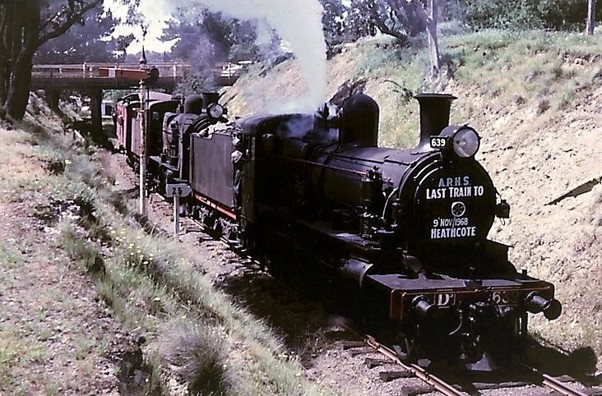
The last train to Heathcote on November 9, 1968. Photo taken at Heathcote Junction and provided courtesy of the Wandong History Group.
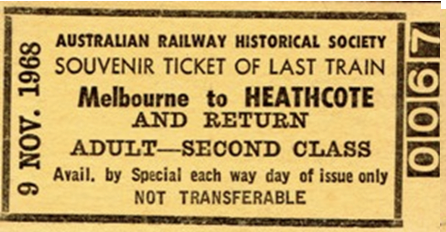
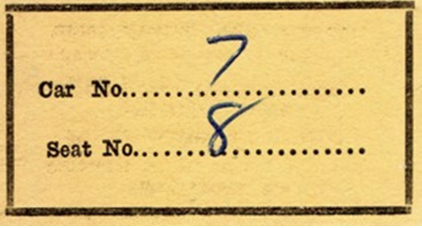
Front and rear of a tour ticket – From The John Debens Ticket Collection.