First Nations Country and Culture

The history of High Camp does not start with a railway line, or land being subdivided for farming. For tens of thousands of years, stretching way back before European settlement, all of this region was actively cared for by the Taungurung and Woiworung clans of the Indigenous Kulin people.

Even now, their connection and cultural and spiritual responsibilities to Country continues. These responsibilities and care run parallel to the story of the railway line, and their custodianship and jurisdiction has never been relinquished.

The Taungurung people would have fished the deep holes of the Mollison Creek and hunted kangaroo and possum and gathered food sources such as Mirniong (Yam daisy), Bracken fern, Tree fern, Cherry Ballart and Kangaroo apple. High Camp is a day’s walk from Wil-im-ee Moor-ring (Mount William), one of south-eastern Australia’s most significant greenstone quarries, where axe heads carrying symbolic, cosmological and social roles were traded as far away as North Queensland. High Camp may well have sat on a busy trading route long before the coming of European settlement and the building of the railway.

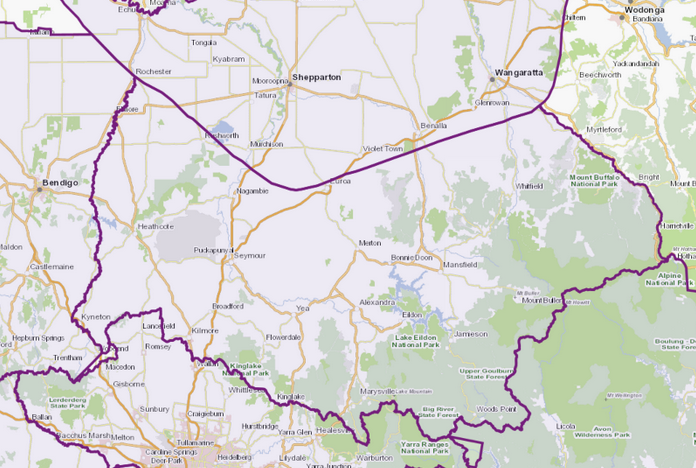
Taungurung country map

High Camp is also a day’s walk from the Goulburn River and its floodplain. The river is a longstanding traditional corridor linking upland and lowland zones for seasonal movement, food resources and inter-group interaction. For Taungurung, Biik Baange was not just a physical river but a major organising axis of Country — ecologically, socially, and spiritually. The High Camp landscape likely sat within broader movement and exchange networks that linked quarry specialists, riverine communities, and other parts of Taungurung Country. Its position between woodlands and creek systems suggests it functioned not as an isolated point, but as part of a patterned, socially organised cultural landscape.

The late John Leahy from “Pineview” Glenaroua had a collection of stone axes he had picked up on his property, offering a small, tangible glimpse of this deep history. As John explained:

“When the ground was bad after a drought, you’d be riding along and you’d see that little bit of a rock just sitting on top of the ground.”

According to the Taungurung people:

“When Europeans first settled the region in the early 1800s, the area was already occupied by the Taungurung people. From that time, life for Taungurung people in Central Victoria changed dramatically and was severely disrupted by the early establishment and expansion of European settlement. Traditional society broke down with the first settler’s arrival and soon after, Aboriginal mortality rates soared as a result of conflict, introduced diseases, denial of access to traditional foods and medicines.”

Since the start of the railway line, the High Camp Railway station has been an important point of trade, with agricultural goods, building materials and other goods travelling in and out, along with passengers. Although there is no specific information about Taungurung use of the area now known as High Camp, we know that trade, travel, agricultural activities, and care for Country, along with cultural and social responsibilities, were key parts of life for Taungurung people — and remain so today.

As Aunty Munya Andrews wrote in the Age Opinion on January 26, 2026:

“This country is capable of holding grief and pride at the same time. We can acknowledge the past without being trapped by it. And we can learn from the oldest cultures in the world how to listen more deeply. That is where real healing begins.”

European Settlement

European settler interest in the region stemmed from Major Thomas Mitchell’s 1836 exploration of inland New South Wales. Favourable reports of fertile land south of the Murray river triggered an influx of settlers and pastoralists to this area.

Among the earliest settlers was Alexander Fullarton Mollison who, in December 1837, staked out 64,000 acres on the Coliban river near Malmsbury. He continued to look for further land and eventually in 1838 settled on an unoccupied area along the Mollison creek, between two other overlanders, Captain Sylvester Brown’s Darlington Run and William Hamilton’s Glenaroua Station. Alexander Mollison was joined by his brother William, who was put in charge of the Pyalong Run. (Pyalong is an aboriginal word meaning “two small waterholes dug by women.”)

By 1847 a shearing shed had been built on the Pyalong Run, east of the Northern Highway and opposite the Mollison Memorial. That year Alexander Mollison wrote to his sister and reported on the shearing –

“I do not bring them to Coliban as formerly but have built a shearing shed at Pyalong. I began rather earlier in the season this year, and the weather being fine, I finished this somewhat heavy task in four weeks. About 500 or 550 sheep were shorn every day, and the wool packed in bales ready for shipment.”

Sadly, the shearing shed was eventually removed around 1889 to allow for the construction of the Heathcote Junction to Bendigo railway line.

The Mollison brothers complained of the difficulty maintaining farm employees and the discovery of gold in 1851 only added to this problem. The construction of a homestead at Pyalong (now called Mollison Park) was delayed until 1859. When Alexander Mollison returned from a visit to London he reported –

“The new house at Pyalong is commodious, comfortable and cheerful and standing on rising ground and dry soil. There are plenty of trees around but not too close to the house. It is nearly a quarter of a mile from the high road.”

The adjoining Glenaroua Station was also established as a sheep run in 1838 by William Hamilton. The Glenaroua Homestead, built of bluestone, was erected in stages between the 1850s and 1860s. Despite changes over the years, particularly internally, the building today retains much of its original appearance.

In the 1860s land selection opened up the area to smaller farmers and small communities began to emerge at High Camp Plain (later shortened to High Camp), Glenaroua and Pyalong. The late Walter Crawford in his journal reports that his father donated one acre of land near his home for the High Camp School No 2276 which opened in 1880 – this school later moved to the station precinct.

According to Crawford, a Mr Edmond O’Hern selected the last available land at High Camp but part of this was repossessed by the Government for the railway site.

At this time life was challenging. Labour shortages were common and the isolation of the district made transport difficult. These conditions would eventually drive the demand for improved connections – most notably a railway.