
Agriculture
Agriculture was the backbone of the Twentieth Century High Camp economy with sheep, cattle and dairy farming dominating the landscape with produce transported by rail to markets and processing facilities.
Farmers drove livestock to the station, often co-ordinating carefully to avoid mixing up their animals. The physical effort involved in loading wagons was considerable but farmers all worked together. Working on the railway loading docks was not without its hazards however. A 23-year-old man was filling wagons in 1889 when a large stone fell and crushed him.
Cream and cheese were also transported by rail to the former Kilmore Butter Factory. The cartage of superphosphate fertiliser to the region was another big earner for the railways.
Between the present day Crawfords Road and the buffer stop are the remains of the stock yards loading platform. Pieces of concrete, possibly from the stockyard fencing, are also scattered in this area. The original road crossing is behind the buffer stop as depicted in the images below.
Several members of the High Camp community remember droving and loading sheep in the 1930’s and 1940’s.
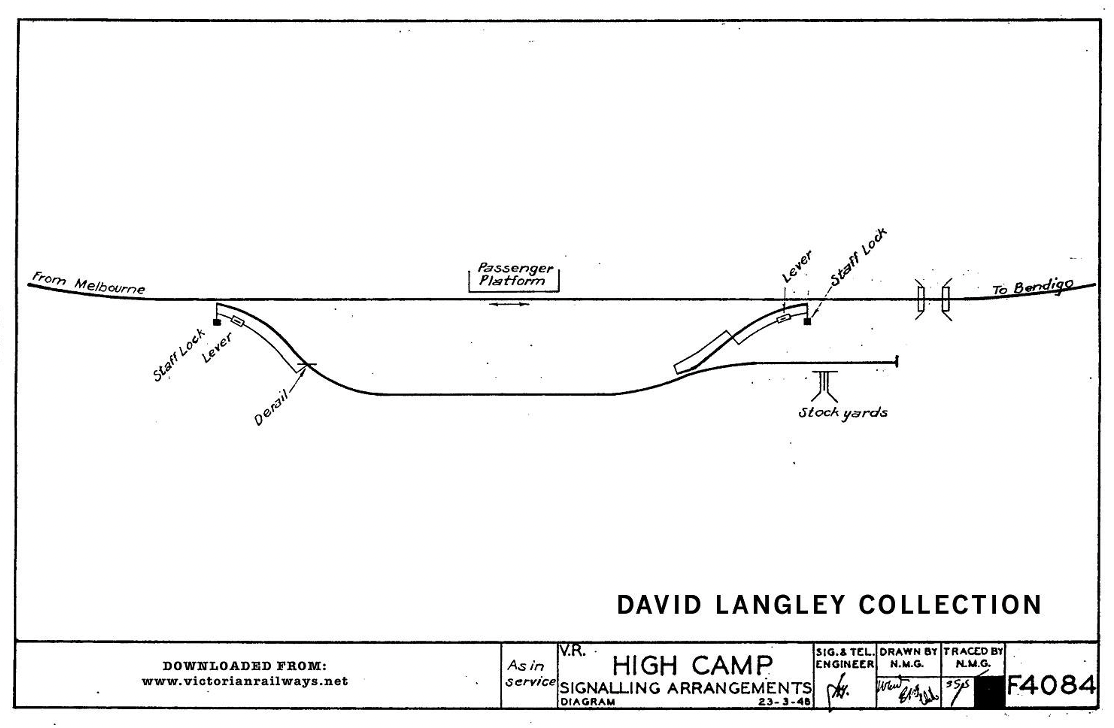
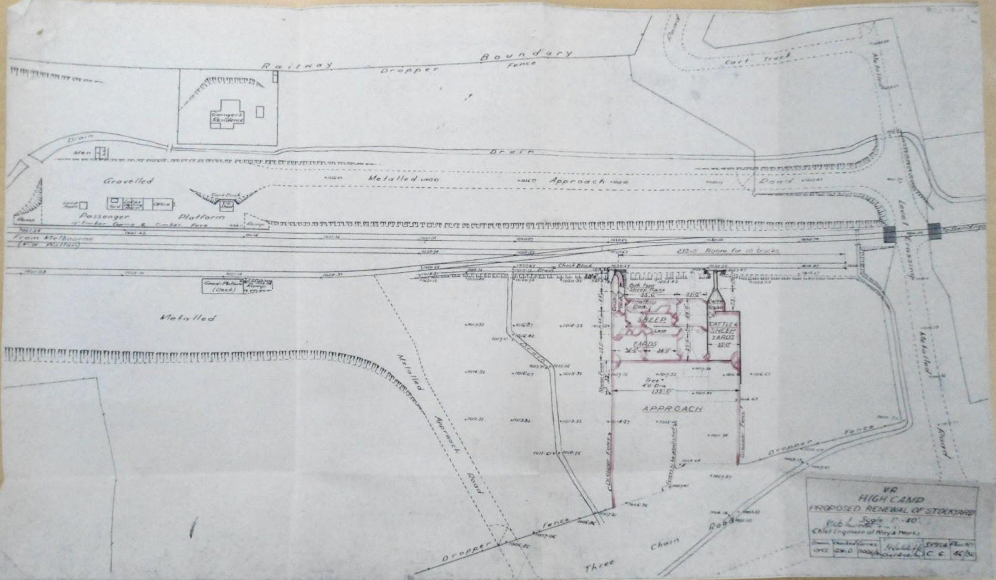
Diagram of the High Camp station showing the loading yards
“We used to walk our prime lambs from our farm on Fullard’s road to the High Camp railway station where they would be loaded onto train carriages to go to Newmarket saleyard in Melbourne. There were no livestock trucks in those days. The Northern Highway was just a dirt road.”
Ray Fullard, High Camp.
“Farmers drove their sheep up from Glenaroua and down from High Camp to the station. There were no box-ups or anything. They managed to keep the sheep all in separate mobs mainly, and the lambs were freshly weaned straight off the mother.”
“They couldn’t have been big mobs because there weren’t a lot of sheep as the country was pretty poor in those days. The sheep would have been mainly crossbreds. Well, they were all crossbreds up until 1951 or so, when the price of wool went through the roof and they started bringing in fine wool merinos.”
Col Stimson, High Camp.
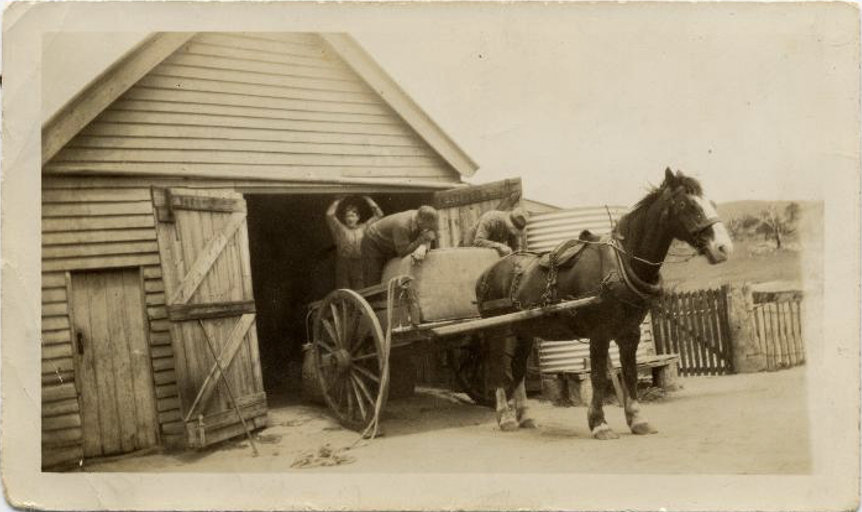
Loading wool bales to cart to the High Camp railway station. The Stimson farm “Ridgmount,” High Camp (thought to be circa 1910-1920)
“In the springtime, of course, when the lambs come on, everybody would have to drive their lambs to High Camp. Sometimes it was very close that the lambs would get boxed up with the next-door neighbour’s lambs. So, you had to communicate to make sure that there were some time and space between each mob of sheep. And then of course, any sheep that were bought always came in on rail trucks because at that stage the road transports were just starting to get going.”
“If there were several rail trucks going, and some days there would be, because there would be Shanahans, Crawfords and Stimsons, coming into springtime, when the sucker lambs were all ready, there might be up to eight to 10 trucks in line. The carriages had to be separated. You had to undo the hose and everything and then you had a couple of bars that you put on the line, behind the wheels on the rail truck. And you kept shifting the bar along and shifting the truck into position, so that the gates on the loading ramp lined up with the trucks for the stock loading to go ahead.”
“Well, they didn’t run because of the level. You had to get the bars out again behind the wheels of the truck. They’d have special crow bars, with a sort of hook on and you put them down behind each back wheel on the truck and you sort of lever it in. Once it started to run, there’d be a few hands-on deck there so that you could push it, push it the other way, so the next truck could come in and load. They all sort of joined in and helped. I mean there might have been a dozen farmers there and they’d all help.”
“Dad used to drive a jinker up there to take cream up twice a week to the High Camp station to go to the Kilmore Butter Factory. The cream had to be taken up, and you picked up the empty cans that were waiting there. The cans were there that they’d sent back, by train again.’’
“Superphosphate came up on the train to High Camp station. It was loaded into 180 lb bags that we had to unload onto a trailer to cart home.”
the late John Leahy, “Pineview” Glenaroua, 1930s.
Rabbiting was also a big business. Ray Fullard remembers going with his father to load bags of rabbit skins on the train in the 1930’s. “Pyalong and High Camp survived on rabbits”, he said. “You ate them and everything.”
Sand mining
The railway also provided transport for a new industry that developed in Pyalong in the early 1900s. The sand from Mollison’s Creek “was recognised as being of excellent quality” and was “very much in demand in Melbourne by the building industry.”
Various methods were used to extract the sand including using pumps set up on concrete foundations on the bank of the creek. One of the sand miners was Percy Herbert Hiscock who was born in Pyalong in 1866.
Sand mining of Mollison’s Creek became the main labour industry in Pyalong with more than twenty men employed in 1924. The Mollison Sand and Gravel Company laid down tram lines for side-tipping trucks used to take the sand to the station where it was transferred to railway trucks. At times there were nine train loads a week carrying sand to Melbourne and two additional lines were laid in the Pyalong railway yards to cater for extra railway trucks.
However by 1968 “the sand had almost stopped coming down Mollison Creek” and the sand mining industry came to an end.
(Reference: Lorraine Huddle Pty Ltd: Architectural Historians: Professional Heritage and Design Consultants Director: Lorraine Huddle B. Architecture (Hons) Melb. ICOMOS 53 / 364 Pyalong Rural Town Precinct Volume Five of Five: Precinct Documentation continued Mitchell Shire Stage Two Heritage Study 2006)
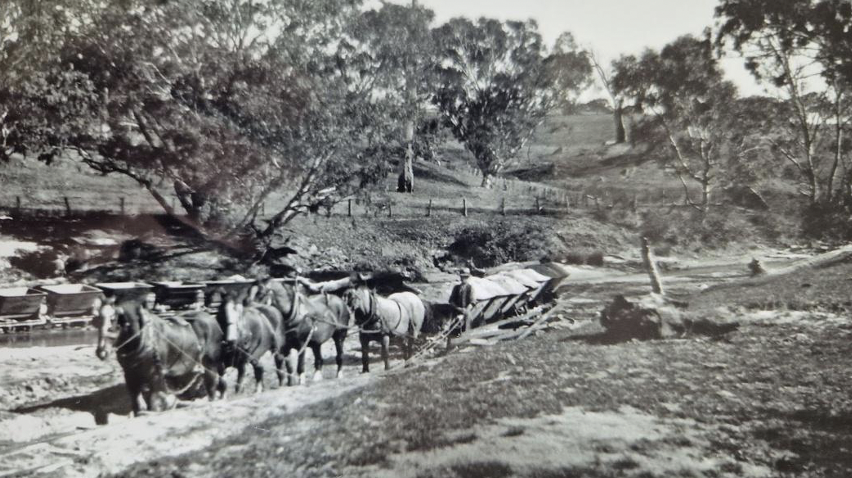
Horses carting sand along a wooden tramline at Pyalong (from Chris Cooke, Pyalong, taken by his great uncle Joe, circa 1920).
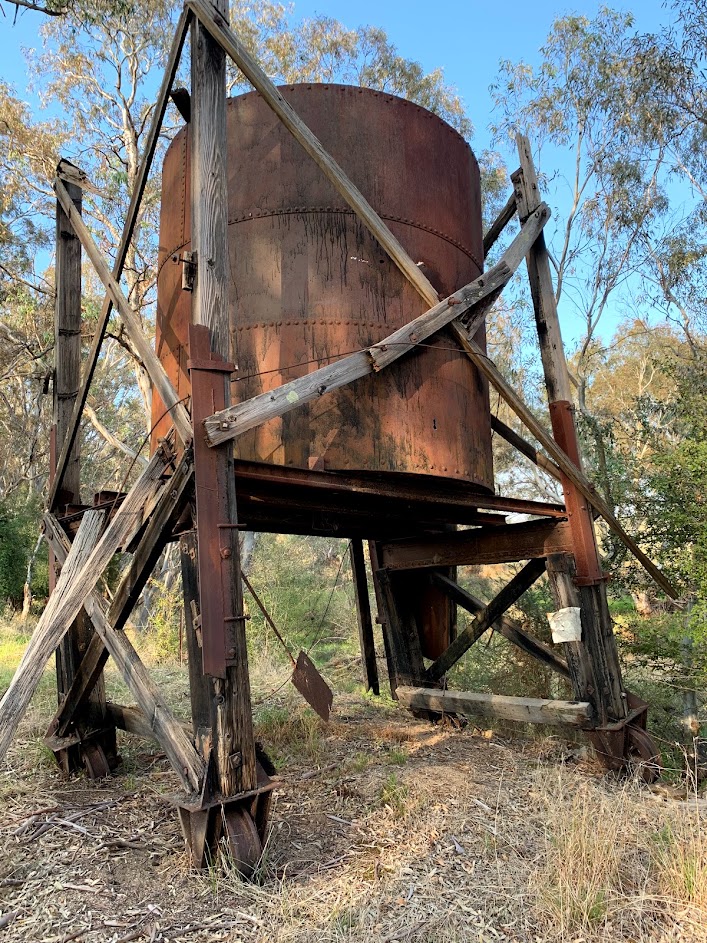
The sand hopper in 2021. Photo credit: Tim Budge
The late John Leahy on the sand extraction from the Mollison Creek at Glenaroua.
“Bluey Ruden had a side loader with a big scoop on it that would go backwards and forwards across the Creek and bring the sand up into a slide and his truck would be backed underneath it and tipped the sand into the truck yeah.”
“He had an old Albion truck with a fairly large engine which drove the pulleys that had cables on. And the scoop would go over and come and pick up the sand and come back again and turn around and keep going around in circles. But I think they call it a side loader.”
“Then they started to pump the sand out of the creek further down at the corner where there was still sand, but the sand was pumped up with water into a hopper. And then the trucks backed in underneath the hopper- that was more easily managed than the old side loader. But I think there was a fair bit of expense in replacing pumps all the time that were pumping sand and water.”
Timber
Timber was once big business for the rail line. Felled trees were transported to Melbourne for firewood and to Bendigo to shore up the mine shafts. Timber loading at High Camp station was substantial. In 1959 over 10,000 tons of timber were loaded onto the train. Seven years later however it had dwindled to one ton.
Recollections from Des McLean, Glenaroua:
“After World War I, my grandfather (Harold McLean) came home and started up a wood cutting business. He employed 13 wood cutters in the district. Trees on farms that had been ring barked were cut down with axes. (The timber had to be dried out to sell). The felled timber was taken to the High Camp railway station. At the station there were two saw benches operated by stationary motors. Grandad’s (Harold’s) workers had to saw off the nib (the mark left by the axe) and cut the timber into foot-long blocks and then stack them into the railway wagons. The firewood was sent down to a Moonee Ponds wood yard. My dad’s (Ken) job was to collect all the nibs to take home to use in the wood stove. Dad would have been only eight years old when he was doing this. Sometimes Grandad would ride his horse down to Coburg to visit relatives and then ride over to Moonee Ponds to the wood yard. It was a day’s ride from his home (Whitegate Rd) to Melbourne. He would walk the horse for a mile, then trot for a mile and then canter for a mile.”
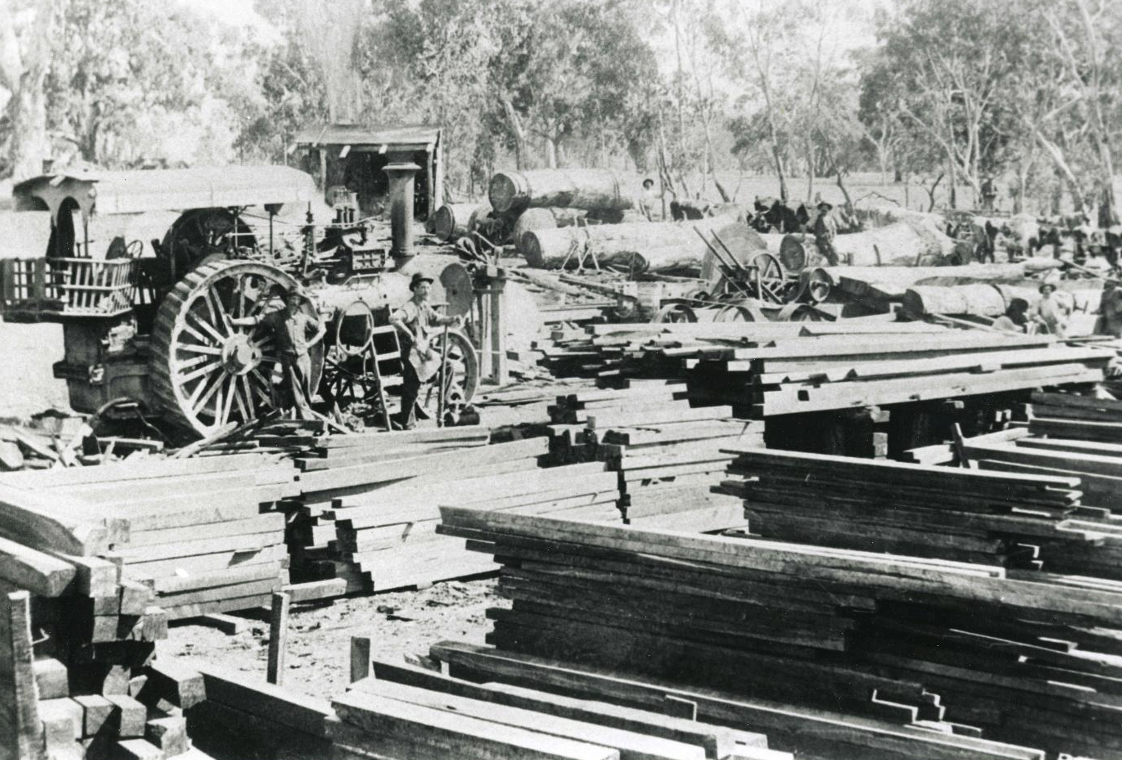
Crawford’s timber yard. Photo courtesy Kilmore Historical Society.
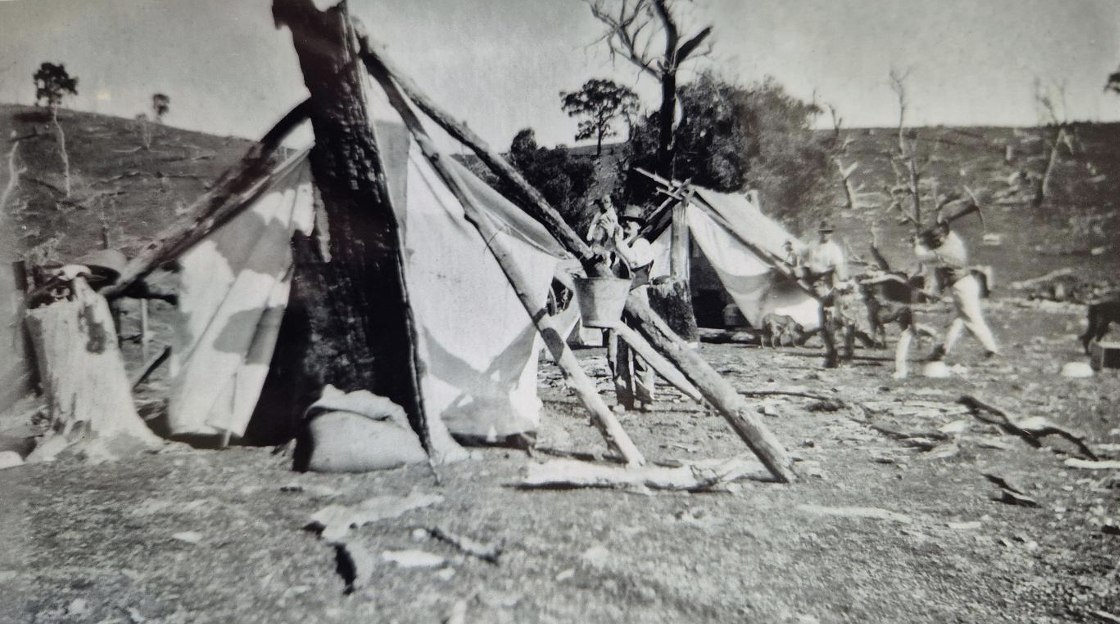
Cutting timber around Pyalong. Photo courtesy Chris Cooke, Pyalong, taken by his great uncle Joe, circa 1920.
“The Moonee Ponds wood yard was very fussy about the quality of the firewood being sent to them. If the blocks were twisted or had any charcoal on them, Grandad would get docked. Later on, my Dad kept going with the firewood business. He would cut wood and take it down to Campbellfield (Melbourne) in his truck.”
“Cutting and selling firewood to Melbourne was a big source of income for many landowners. Grandad and his brother applied for a discharged soldier’s purchase lease to acquire two blocks (320 acres each) of land on Chapmans Rd, Glenaroua. They cleared the trees from these blocks for firewood. There were also many returned soldiers who purchased blocks at Puckapunyal, and having no farming skills, survived by cutting down trees and selling firewood. A private railway line and tramway called the Majors line, was built and ran from Puckapunyal to Tooborac to transport the firewood. When the trees ran out, these landholders had no income and sold the land to the Tehan family. Eventually this land became the Puckapunyal army base.”
The McIvor Timber and Firewood company built and operated the private line that ran from the forest areas around Puckapunyal/Graytown to Tooborac, in the early part of the century. The company had been formed principally to supply timber for the mine operations in Bendigo. The company used the line to carry timber to its mills near the main line. A siding opened up about 1.2 km north of Tooborac in 1905 to allow the Victorian Railways locomotives to enter the private railways yards to pick up a load of timber. In addition to transporting timber in various forms, the line also carried large quantities of charcoal most of which went to Bendigo. The McIvor Timber Company ceased operations in 1926, when they went into voluntary liquidation, and the line was dismantled.