
The following oral histories offer personal insights into life in High Camp across the generations. They reflect the diversity of experiences that shaped the district, from farming and family life to work on the railway and local industries.
The Fullard family
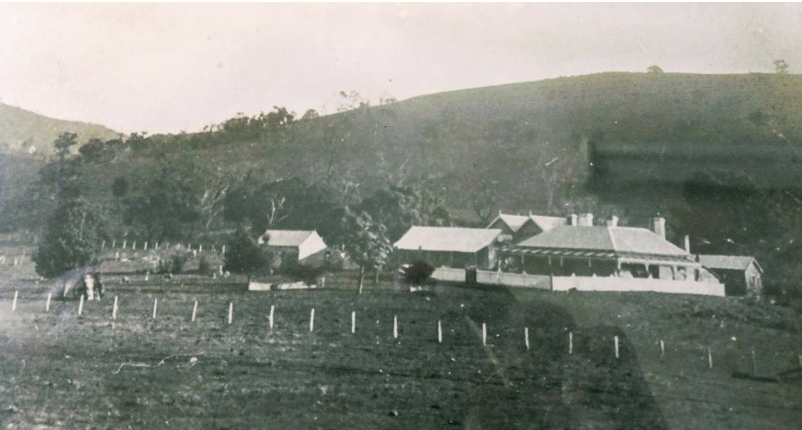
The original Mollison house and 640 acres remains on one title and has passed through many hands, but the longest continuous ownership 1923 to 2022 has been the Fullard family.
Samual Fullard was an accountant working in a management role at Treadways department store in Melbourne. His youngest son, Gordon, went to Dookie to study agriculture and after working on farms near Edenhope, wanted to obtain his own property. Samual was willing to purchase a property, but as he was unable to drive, he wanted a property close to a railway line. Hence his choice of “Mollison Park”. Gordon was a progressive farmer and set about using the skills he had learned at Dookie. He was joined by his brother Norman who was interested in all things mechanical. According to Gordon’s son Ray, he was the first in the district to own a tractor and as an early adopter of super phosphate he planted a variety of crops and irrigated the flats in front of the house.
With the establishment of the High Camp settlement and the railway, more outsiders moved to the district. Gordon met his future wife, Mabel Millard, when she was appointed temporary station mistress, and Norman married Miss Mary Wright who was appointed teacher at the High Camp school between 1923-24.
Gordon and Mabel had nine children who enjoyed a happy childhood at “Mollison Park.” The children went to Pyalong school and eventually after Norman’s sudden death, Ray began work on the farm.
Ray helped his father milk about 70 cows, initially by hand, and then with a rudimentary milking machine – cream was sent on the train to the Kilmore Butter factory and milk was supplied to both Kilmore and Heathcote.
Ray said the milk
“was all kept in a big 70-gallon vat and then you hand separated it, and milk and cream went to Kilmore. They fed calves or pigs with the skim milk.”
The train was used to transport livestock and deliver super phosphate. Ray remembers going to the station with a horse and dray to get super phosphate.
“You’d have to hook the chain off from the cone super spreader. Go to the railway station, put the Super on, walk back, put the chain back on, go into the paddock and spread it. Now you couldn’t put any more than about 7,180 lb bags on because the horse couldn’t hold coming down that steep hill.”
Herding lambs to the station was also a difficult job – the lambs had to be separated from their mothers and prevented from bolting back home, before being driven along the Northern highway to the station.
Ray had some interesting exploits with one of the Railway employees, Des O’Toole, who was stationed at High Camp station. After work, Des loved to help the Fullards with hay-carting so he built himself a trolley to get from the station to “Mollison Park” on the line. Ray helped him install a more powerful motor taken from a motorbike, so Des could get back up the hill to the station!
Des was also Ray’s co-conspirator in Ray’s claim to have driven a small tractor over every railway bridge between Willowmavin and Tooborac. Apparently instead of burning the edges of the railway easement to prevent fires, the railways were going to rotary hoe the earth following spraying. Ray got the contract to do the spraying.
In 1937, to celebrate the Pyalong centenary, it was decided to build a memorial to the Mollison brothers. The Fullard family took it upon themselves to build the obelisk situated beside the Northern Highway and it is believed that some of the stones were taken from the old Mollison shearing shed floor.
Ray and his wife Frances still live on Fullard land at High Camp. Interestingly, before she was married Frances travelled daily on the diesel train from Kilmore to Heathcote Junction, there joining the train to Melbourne to undertake her hairdressing apprenticeship.
The Stimson family
“Ridgmount,” the property of the Stimson family at High Camp Plain was purchased by Leonard and Jane Stimson in the early 1880s and takes its name from the town Ridgmont in Bedfordshire, England. Leonard, Jane and their baby sailed to Sydney from England in 1857 and travelled overland to Victoria where Leonard started driving a supply wagon with groceries and stores. The family settled in Kilmore while Leonard went to the goldfields, from where he returned with enough funds to set up a variety of businesses in Kilmore. Interestingly, Leonard was a Kilmore Councillor and a member of a committee which met with the railway Commissioners when they visited Kilmore in 1886. The Commissioners were visiting to inspect the route of the proposed line and hear the various arguments for the site of the Kilmore Station.
In the early 1880s Leonard purchased the property at High Camp Plain and by1887 he was calling for tenders to build an eight-roomed house and outbuildings, designed by Kilmore architect Richard Fennelly and to cost a staggering £1,008.
The late Walter Crawford’s journal explains –
“In a depression on the right of Stimson’s hill, there was a large red gum tree under which Leonard Stimson, grocer of Kilmore, dispensed his wares to the women of the district.”
Leonard died in 1904 and his youngest son Charles took over the farm after his marriage to Ellen Griffin whose family conducted the first Hotel and Post Office (on the Northern Highway where Brendan and Therese Ryan now live). Later Mr Griffin built the Junction Hotel almost opposite High Camp Road and the licence was transferred there.
The five sons of Charles and Ellen Stimson all attended the High Camp School No 2276 adjoining the railway station and one of the younger boys, Geoff, took over the running of Ridgmount. The Stimson family were very involved in the High Camp community, attending the Presbyterian church and keen competitors on the tennis courts.
Colin, Geoff’s son, has early memories of accompanying his father to collect the mail from the station, droving lambs down through a paddock they called “Cantwells” to go to Newmarket on the train, and the occasional trip on the train to visit the dentist in Melbourne.
The Stimson family farmed the property continuously until it was sold to the Hiscock family about 10 years ago.
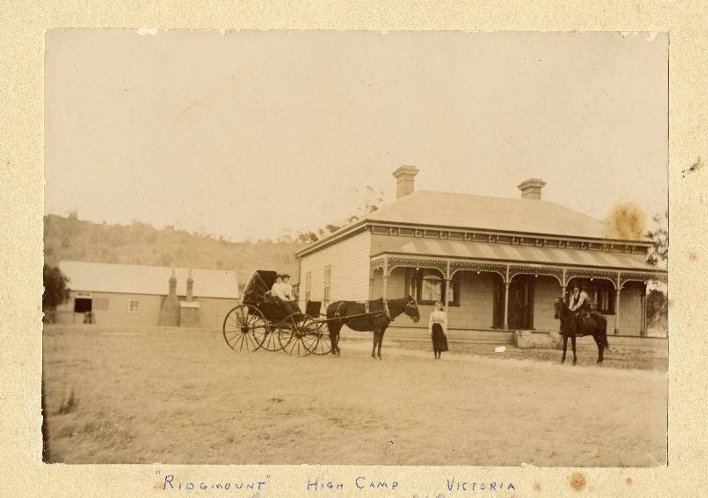
Ridgmount homestead.
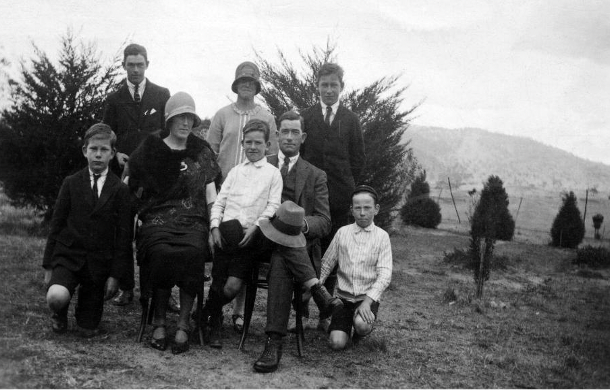
Stimson family, High Camp. Photos courtesy of the Stimson Family Archive.
The Leahy family
The late John Leahy was one of the fourth generation of the Leahy family to take on farming in Victoria, his great grandparents Timothy and Bridget having arrived from Ireland in the 1850s. They initially settled in Avenel but according to John, the rabbits drove them out of that area, and they purchased “Pineview” at Glenaroua in 1922. The land at “Pineview” had been selected in1861 by Mr James Figgins who engaged in farming pursuits, presumably built the house and took a vital interest in public affairs including railway extension agitation.
John was born in 1932, second son to Jack and Eileen Leahy. John spent most of his early years at Pyalong Primary School before leaving school at 14 to join his father and later younger brother on the farm.
One of John’s first memories was of going to the Melbourne show with his two maiden aunts. They were driven to High Camp station to catch the steam train to Heathcote Junction, changing trains there to complete the trip to Melbourne. He remembers being able to open the windows of the train but being told not to put your head out or “you’ll get a face full of soot”
John also had an amusing story about a trip in his father’s prized Hupmobile car.
“One time when we had to go to the dentist. He spent a lot of time adjusting the brakes because it had mechanical brakes on it. And he must have left something a bit tight, and we were heading to Melbourne. He got to High Camp, and we could get this awful burning smell and ohh he’d tightened the brakes up too much, so he pulled into the railway station. A couple of buckets of water there, he got, and he threw the water over the brakes of the car. And then we continued on to Melbourne.”
In the springtime, the Leahy brothers would have to drive their fat lambs from Glenaroua to the station along Whitegate road. From what John remembers, his father Jack would ring the stock agent to order a stock carriage and they would have to coordinate with other local farmers as to the timing of their sheep on the road to the stockyards at High Camp. John well described the method for moving the carriages into position.
“The actual crowbar was just a normal big Crowbar. It had a hook up like that, so you put it on the line. You had a crowbar on each side and you just levered it, and once it started to move just a little, there’d be a lot of hands on deck, you could keep on shifting it along with the bar until we got it to the stage where we’d be able to move it out of the spot for the next carriage to come in.”
Sand was extracted from the Mollison creek near the Leahy property. John remembers the contractors Plowrights using a side loader truck and a powered scoop to extract the sand and then updating to a system where sand was pumped into a hopper that the trucks could drive under to collect the sand.
John has memories of the early rail motors just having one carriage but having stripes at the front like zebra stripes or a barber’s pole. The train was then updated to a diesel rail motor with one carriage.
John, his wife Sue and four children lived at “Pineview,” alongside brother Kevin, Brenda and family, until they decided to sell in 2001 to retire to Broadford.
Sadly, John died at 93, about six weeks after our interview, so we are very grateful to John for his valuable information and generosity. RIP John.
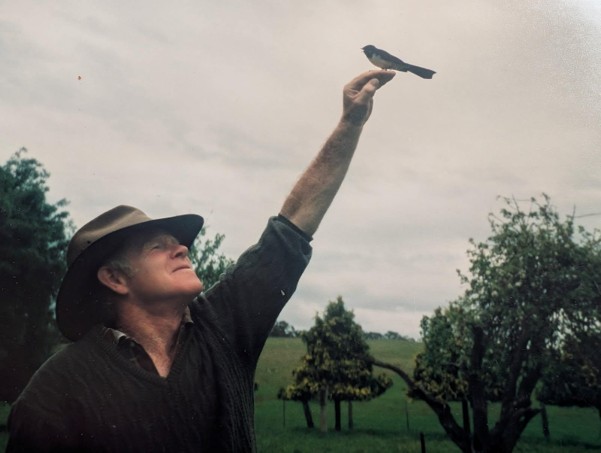
The late John Leahy. Photo courtesy the Leahy family.
The Crawford family
William Crawford left his business in Glasgow in 1852 for a brief visit to Melbourne and decided to emigrate, and by 1854 he had set up a shoe store at the corner of Gore and Gertrude Street Fitzroy and married Miss Jane Johnston. About 1857 he selected land on the banks of Mt William Creek. After clearing the side of a volcanic hill, William planted 5000 grape vines and before long Crawford wines were being sold in Kilmore, Heathcote and Costerfield. William also set up a boot and shoe shop, employed a bootmaker, and had a good trade in Wellington boots.
“Rock Vale” homestead had been built by a Mr J.D. Jamieson a local manager of the Land and Mortgage Bank of Vic. He had grand plans for the house to be hewn from local granite, but with the difficulty obtaining stonemasons and builders, he eventually went insolvent. The house and farm were sold to William Crawford in 1875, and he quickly set about running a productive farm experimenting with crops such as wheat, barley, potatoes and even tobacco.
William Crawford donated an acre of land near “Rock Vale” homestead for the High Camp School No 2276 which functioned from about 1880 to 1907 when it was relocated to the station area. William also donated land adjoining High Camp road for the Presbyterian Church.
William built up his milking herd and began making cheese with great success, winning prizes throughout Australia and in 1884 was awarded the gold medal for cheese at the International Exhibition. In 1890 a new Cheese factory was built with a capacity of dealing with 400 gallons of milk a day, requiring supplementary milk bought from local farmers. In 1910 the cheesemaking at “Rock Vale” ceased and according to son Walter Crawford’s Journal – “it was a very exacting process, one had to be on the spot all the time – I had had 16 years of it and was glad when this business was closed down”. From this time on Walter Crawford worked the farm mainly as a grazing property. This was continued by his sons Berry and Kelvin and the “Rock Vale” home remains very solid and little changed since it was built. This section of the property is still in the hands of the Crawford family.
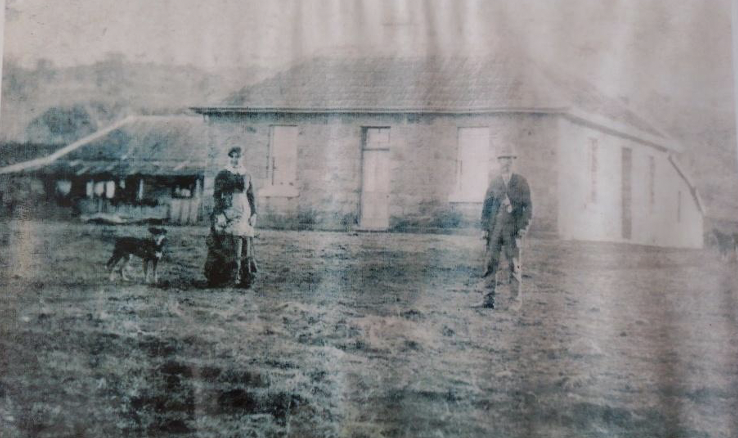
William and Jane Crawford at the original Rock Vale Homestead, late 1800s.
Rock Vale Homestead a productive High Camp farm belonging to the Crawford family, early 1900s
Photos courtesy of the Crawford family.
The McLean family
The McLean Family originated from the Island of Coll, off the northern coast of Scotland. They initially settled at Warrnacknabeal but in the 1880s came to live in the Glenaroua district, on a property that had been selected in 1878 by a man called O’Reilly.
According to Des McLean his grandparents had the property where Allan and Bruce McLean now live on Whitegate Rd Glenaroua, and where Des’ father Ken grew up. Ken bought “Kilbride” from his Uncle Lachie who had been gassed in WWI and wasn’t able to work the farm. Phil and Des now live at the family farm “Kilbride” on the Broadford-Glenaroua Rd.
After the first World War, Des’s grandfather, Harold McLean, ran a timber business employing 13 people. Trees were ringbarked, cut down with axes, allowed to dry out, then taken to the sawmill at the High Camp station. As a boy, Ken McLean helped his father stack the timber in the carriage and would collect the “Nibs” (the off cuts with the axe marks) to take home for the fire at their home.
Harold McLean’s grandsons remain on the land at High Camp, both the original farm on Whitegate Rd and “Kilbride.” They continue to farm the land as well as earning income from off-farm businesses. The family remains involved in the local communities of High Camp and Glenaroua.